Medical Record Review Software for Legal Teams
Cut review time, surface key treatment facts faster, and give attorneys a cited record they can interrogate instead of a stack they have to reread.
Medical record review is where legal teams lose the most time before they can apply judgment. Long files require hours of sorting, scanning, and cross-referencing before anyone can answer basic questions about treatment history, restrictions, diagnoses, or provider opinions.
File Logic turns review into a structured workflow. The system reads every page, makes the record searchable, extracts timeline events, and lets attorneys ask direct questions against the file without losing sight of the source material.
That means your review process becomes repeatable. Staff can prepare a file faster, attorneys can get to the important issues sooner, and the case team spends less time chasing facts that should have been easy to find.
A legal review workflow that starts with the record and ends with strategy
Generic review tools are usually built either for document storage or for abstract AI chat. Legal teams handling medical records need both structure and analysis. They need to know what is in the file, where it came from, how it changed over time, and whether the answer can be supported under scrutiny.
File Logic combines OCR, chronology generation, search, and citation-backed answers so the record review process is not spread across five separate tools. The same uploaded file powers the timeline, summaries, question-answering, and export workflows.
Searchable records instead of static PDFs
Faster review across large provider sets
Cited answers for attorney verification
Better handoff from staff preparation to attorney analysis
Why record review becomes a bottleneck
Review time compounds across every case because the record has to be re-read before each downstream task.
Multiple handoffs
Staff and attorneys duplicate effort
One person organizes the file, another summarizes it, and an attorney still has to reopen the record to answer the real case questions. Review time keeps stacking because each stage starts from scratch.
Buried evidence
The file answers the question, but no one can find it quickly
Whether the issue is treatment frequency, a work restriction, or a provider opinion, the relevant proof is often present in the record. The challenge is locating it quickly enough to use it while the case is moving.
Missed leverage
Slow review delays decision-making
Attorneys cannot price risk, shape a demand, or prepare for hearing efficiently if the review package arrives late or still requires manual fact-checking. Slow review weakens the rest of the case workflow.
A faster review loop for record-heavy matters
Ingest and normalize the record
Upload PDFs and scans into one workspace. File Logic handles OCR and organizes the material into a searchable review surface so the team does not waste time trying to make the source file usable first.
Move from document search to case questions
Instead of relying on text search alone, users can ask direct questions about treatment history, diagnoses, gaps, restrictions, and provider opinions. Answers stay grounded in the uploaded file with citations.
Reuse the same review work across outputs
Because the review layer, chronology, and summaries all draw from the same record set, the work your staff does once can support attorney analysis, exported summaries, and later case preparation tasks.
Review tools that help the attorney move faster
File Logic combines search, annotations, and citation-backed answers so the record review surface becomes useful beyond intake. Teams can flag findings, preserve context, and keep the record organized while still moving quickly through long files.
That matters most when the case is active. Instead of sending around static summaries and asking someone else to verify them manually, the team works from one cited record view that is built for collaboration and follow-up questions.
Search across uploaded records
Citation-backed question answering
Annotations and collaborative review
One shared review surface for the case team
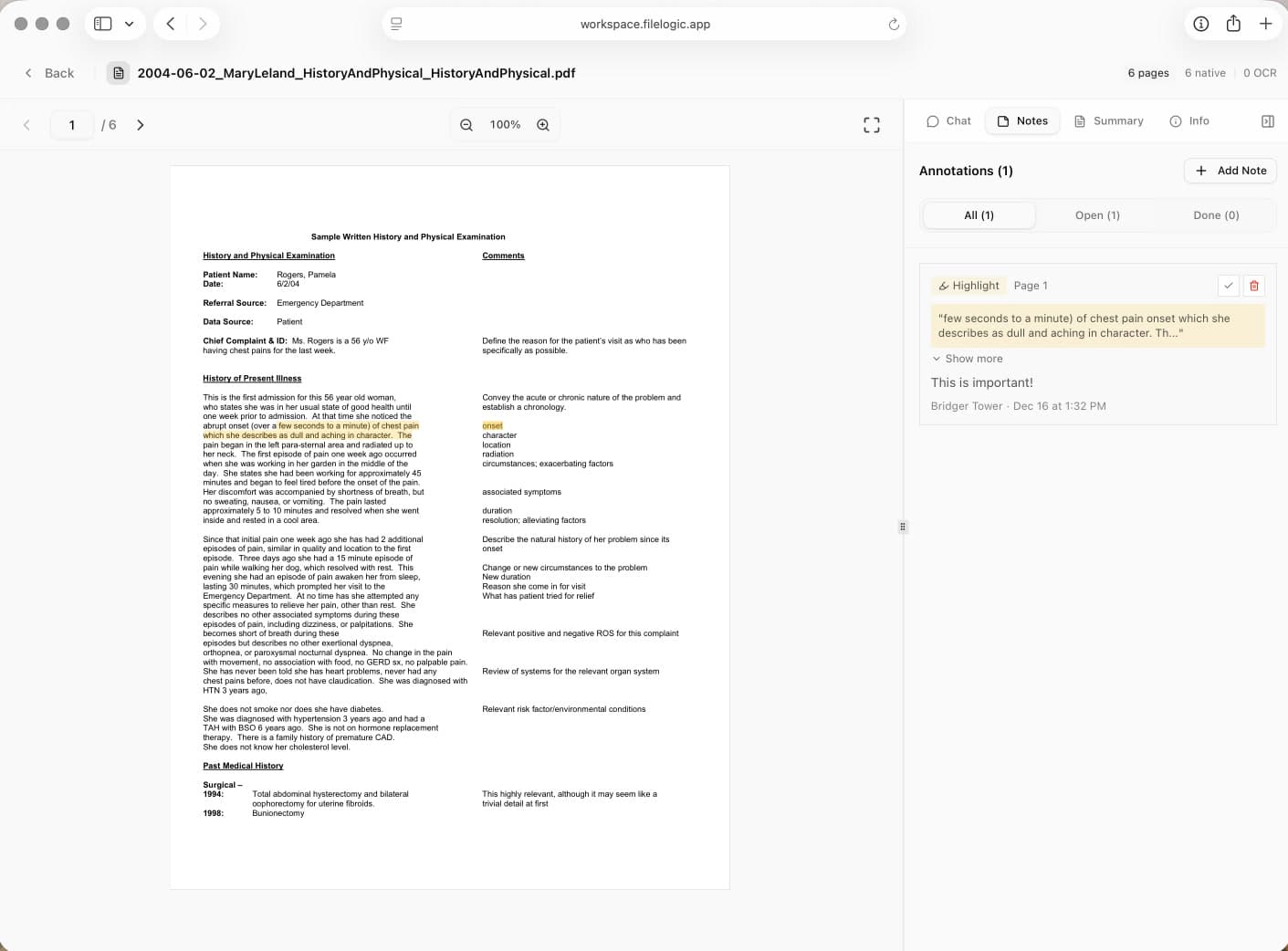
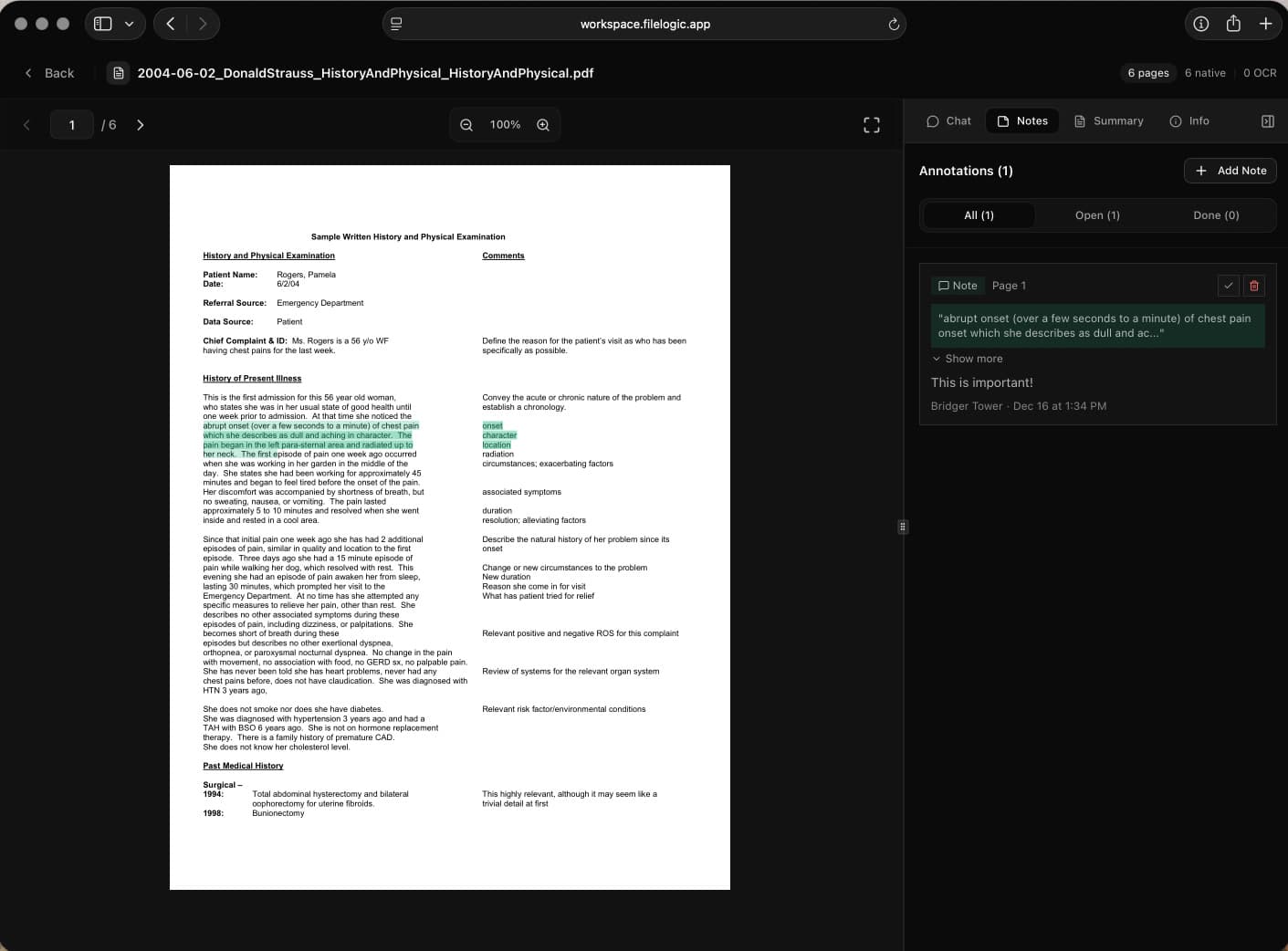
The review surface combines searchable text, annotations, and citations so legal teams can move from intake to analysis faster.
Secure enough for active legal matters
Medical record review software for law firms has to support real client work, not only sample files. File Logic is built to support that standard with secure storage, account isolation, and a trust posture that can stand up in buyer diligence.
For firms evaluating vendors, that means the product conversation does not stop at speed. The platform is designed to support both productivity and the compliance expectations that come with handling medical data in active cases.
HIPAA-ready infrastructure
Secure access controls
Encrypted records in transit and at rest
BAA available when needed
See where this workflow fits
File Logic supports multiple record-heavy practices. Explore the pages below for case-specific language and workflows.
Questions before you book a demo?
Upgrade medical record review without adding more manual steps
See how File Logic shortens review time while keeping answers tied to the record your attorneys need to trust.