Medical Record Summary Software for Faster Case Prep
Create clear medical record summaries without losing the source citations attorneys need to trust and reuse the output.
Medical record summaries are only valuable when they reduce review time without hiding the evidence. A fast summary that cannot be checked against the file creates more work for the attorney who receives it.
File Logic helps firms generate summaries from long records while preserving the context that matters for legal use. Teams can move from source file to timeline to summary using the same uploaded record rather than rebuilding the file story by hand.
That makes summary work more scalable. Staff can produce a usable first draft faster, attorneys can verify key points more easily, and the case team has a stronger starting point for hearing prep, demand writing, or internal strategy.
Summaries that stay connected to the record
The weakness of many AI summaries is that they collapse too much context. Legal teams need more than a neat paragraph. They need a summary that can point back to the chronology, clarify providers, and survive attorney review.
File Logic supports that by grounding summaries in the same document set used for chronology and Q&A. The summary workflow is faster, but it is still tied to the record and the questions driving the matter.
Summaries supported by the underlying file
Faster handoff from staff prep to attorney review
Better reuse across reports, demands, and hearing prep
Less risk of relying on disconnected AI output
Why summary work still takes too long
The problem is not only writing the summary. It is validating it and rebuilding the medical context around it.
Second-pass review
Attorneys still have to reopen the file
When a summary is not tied clearly to the source record, the receiving attorney still has to locate the supporting pages manually before relying on it. That wipes out much of the time savings.
Long file sets
Important context gets compressed away
Large medical records include treatment progression, provider changes, and gap explanations that matter legally. A short generic summary often drops the very context that makes the case intelligible.
Poor reuse
The summary is not easy to repurpose
Teams often need the same material for a chronology, a case memo, a demand letter, or a report. If the summary is too thin or too detached from the record, someone has to rebuild the work again in another format.
A summary workflow that preserves legal utility
Start with the uploaded record, not a blank page
File Logic reads the matter file first so your team can work from structured medical content rather than manually identifying every relevant event before summarizing.
Generate summaries alongside chronology and search
The summary sits within the same workspace as the timeline and citations, which makes it easier to confirm what the platform found and fill in any case-specific nuance before sending it forward.
Use the summary as a base for downstream work
Because the summary is connected to the chronology and source file, teams can use it to support reports, hearing preparation, settlement work, and attorney review with less rework.
Generate summaries that attorneys can actually work from
The record summary view gives teams a faster way to digest large files while keeping the supporting medical context accessible. Instead of choosing between speed and trust, the platform helps legal teams move faster while preserving the ability to inspect the source material.
That is especially useful when a summary needs to evolve. Because the underlying record, chronology, and related analysis stay in the same workspace, users can refine the output instead of restarting the review process from zero.
Summary output grounded in uploaded records
Shared workspace with chronology and search
Easier attorney validation before use
Better reuse for reports and case strategy
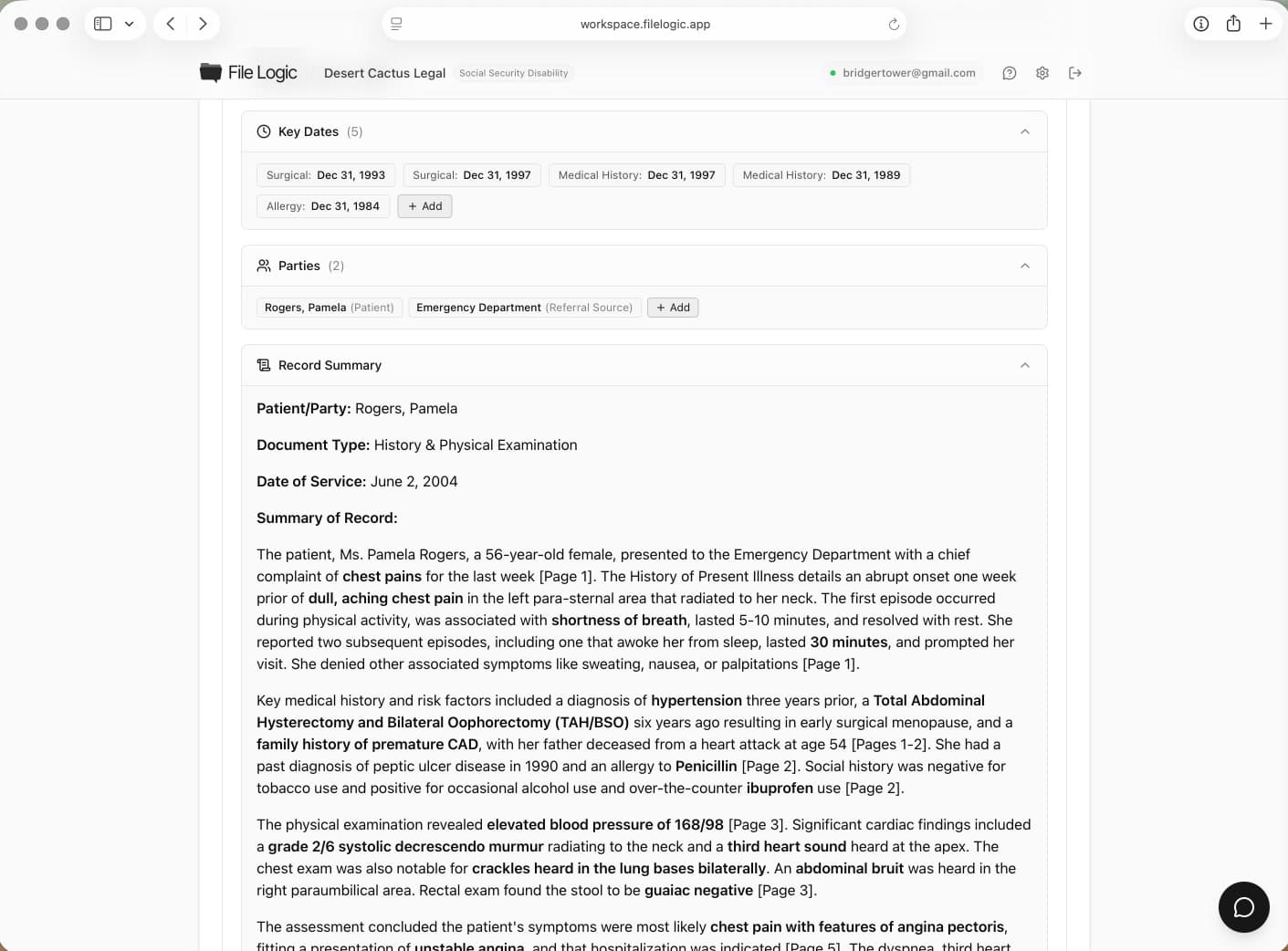
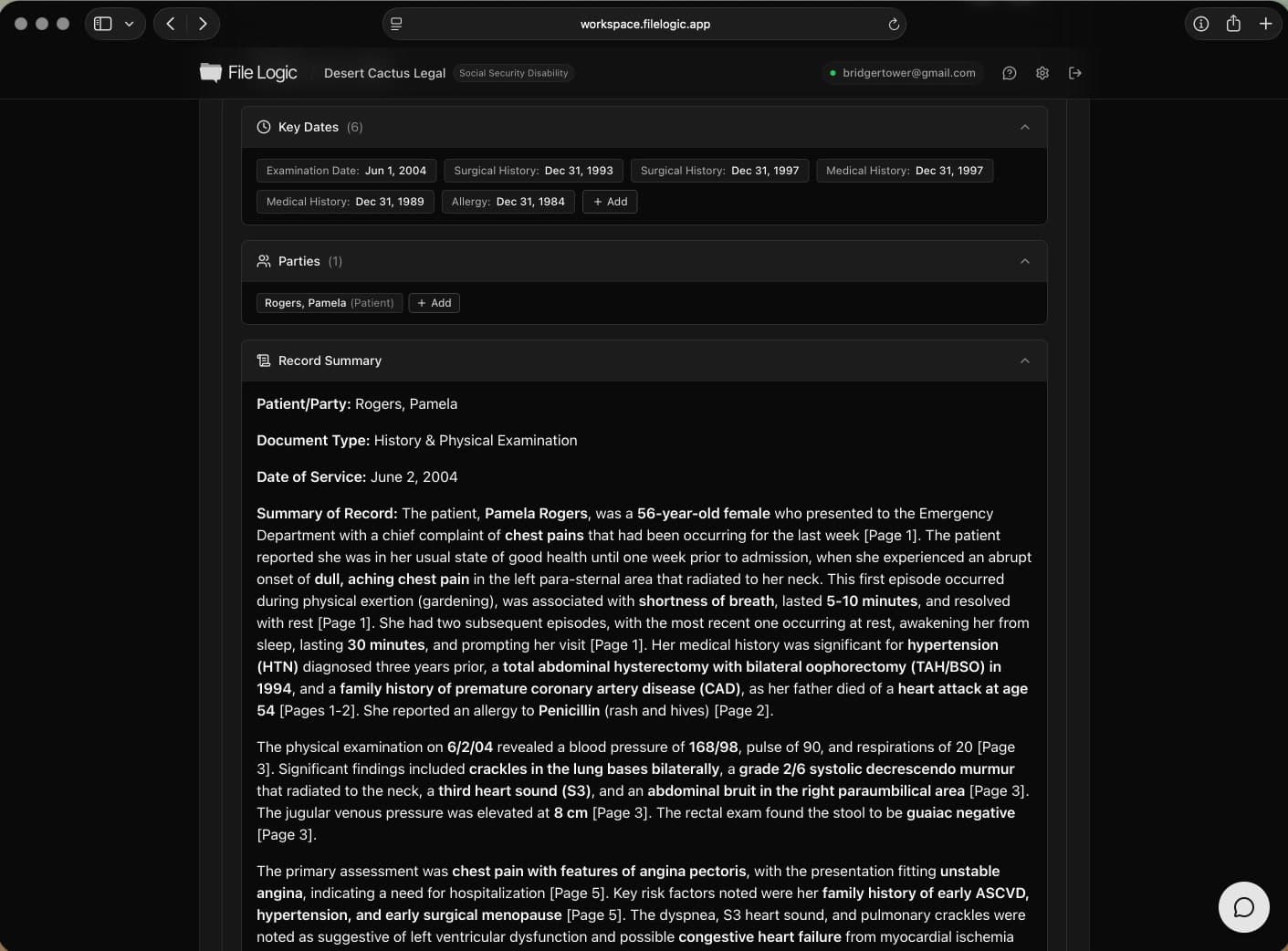
Summaries stay connected to the source file so legal teams can review, validate, and reuse the output more confidently.
Summary automation that still respects the record
Medical record summary software should shorten case prep without pushing firms toward unverifiable black-box output. File Logic keeps the summary workflow attached to the record, which helps attorneys confirm the result before relying on it.
For firms handling sensitive matters, that sits alongside a security posture designed for real client work rather than experimental uploads.
Cited summary workflow tied to source files
Secure handling of uploaded medical records
Encrypted storage and access controls
Platform fit for legal review teams
See where this workflow fits
File Logic supports multiple record-heavy practices. Explore the pages below for case-specific language and workflows.
Questions before you book a demo?
Produce stronger medical record summaries with less rework
See how File Logic helps legal teams summarize large medical files without disconnecting the output from the underlying record.